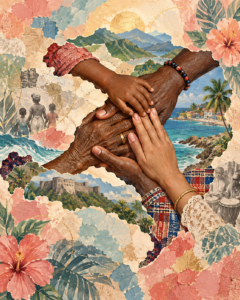
This piece is a celebration of Haiti as something carried from one generation to the next—through family, culture, memory, resilience, and love. At the center, hands of different ages and skin tones come together, symbolizing unity across generations and the strength found in community. Each hand represents a connection: to those who came before us, to those standing beside us, and to those who will carry Haiti’s story forward.
Surrounding the hands is a layered collage of Haiti’s landscapes, coastline, architecture, traditional patterns, music, flowers, and family life. These elements reflect a country whose identity is much larger than any single moment or hardship. The vibrant hibiscus, mountains, sea, cultural textiles, and historic imagery speak to Haiti’s beauty, creativity, and enduring heritage.
The torn-paper effect represents the fragments of memories and experiences that shape our understanding of home. Although each piece is different, together they form something complete and powerful. The artwork is ultimately about belonging—reminding us that Haiti lives not only in a place, but in the people, traditions, stories, and connections that continue across generations.
To me, Haiti is heritage held in our hands, strength passed forward, and a connection that can never be torn apart.
There is always room
for one more chair.
One more plate.
One more story
that begins before you arrived.
Someone is laughing.
Someone is cooking.
Someone is telling the children
not to run so fast.
Someone runs anyway.
This is how memory survives -
not quietly,
but through voices,
food,
music,
arguments,
prayer,
jokes
and doors that remain open.
Haiti-To-Me
is knowing that community
is something we create
again and again.
This piece reflects the spirit of the lakou—a shared space where family, neighbors, stories, food, music, prayer, laughter, and everyday life come together. More than simply a courtyard, the lakou becomes a symbol of belonging: a place where there is always room for another chair, another plate, and another story.
The poem captures the beauty of community through ordinary moments—someone cooking, children running, conversations overlapping, jokes being told, and doors remaining open. These moments may seem small, but together they are how culture and memory survive. They show how traditions are not preserved silently; they live through people, relationships, sounds, meals, faith, and shared experiences.
For me, the lakou represents the idea that community is something we continually create. Even as people move, families change, and generations grow, the sense of connection can be rebuilt wherever people choose to gather, care for one another, and keep their traditions alive